
Bank of Korea: Consider Existing Financial Regulations When Introducing Stablecoins

 Prefer us on Google
On the 10th, Kim Bo-il, head of the Virtual Assets Division at the Bank of Korea, spoke at a discussion on the challenges following the Digital Asset Basic Act held at the Financial Investment Association's Financial Investment Education Center. Source: Park Jae-yeon/Digital Asset
The Bank of Korea emphasized that the differences and conflicts between existing financial regulations and blockchain systems must be considered in the process of introducing a won-based stablecoin. In particular, it is necessary to examine to what extent the national payment system will rely on global blockchains such as Ethereum.
On the 10th, Kim Bo-il, head of the Virtual Assets (Digital Assets) Division at the Bank of Korea, stated at the discussion titled "Challenges Following the Digital Asset Basic Act" held at the Financial Investment Association's Financial Investment Education Center in Seoul, "The existing financial system and blockchain system have very different environments, making it quite difficult to design regulations."
Kim pointed out that the relatively slow discussion on the introduction of a domestic stablecoin compared to overseas is due to the developed payment infrastructure and financial regulatory framework.
He stated, "Many countries have established laws related to stablecoins and digital assets, and considerable discussions are ongoing in our country as well," adding, "Our country is progressing relatively slowly, and I believe there are reasons for this."
He continued, "Looking at the characteristics of our financial market, the payment system is quite developed," and explained, "Convenient payment systems are well established, and the 24-hour banking payment system and other payment infrastructures are well equipped."
Kim mentioned, "In this situation, since the public does not feel much inconvenience, there may be a lack of demand for new payment methods."
He also presented the existing financial regulatory framework as a factor affecting the introduction of new systems.
He stated, "Our country has a highly developed financial market globally, and the regulations are abundant and well-designed," and added, "In such a situation, introducing a new system is quite challenging."
He also mentioned the competitive effects of introducing stablecoins.
Kim said, "I believe that the entry of stablecoin platforms into the market will promote competition," but noted, "For competition to occur, it must happen in a similar environment."
He further explained, "The existing financial system and blockchain system have very different environments," and that many are contemplating how to apply the regulations that apply to the existing financial system to blockchain.
In particular, he pointed out the difference between the anonymity of blockchain and existing financial regulations.
He stated, "The popularity of blockchain is partly due to its anonymity," and added, "Currently, public blockchains are dominant, and if we apply the existing financial system's regulations directly, it may become difficult for new businesses to compete."
The Bank of Korea is also preparing to maintain the role of the central bank in anticipation of the expansion of the digital asset market.
Kim stated, "The Bank of Korea is preparing and striving to continue its role as a central bank in a world where tokenization is possible."
He explained, "Not only stablecoins but also when tokenization and blockchain technology combine with the financial market, they will all impact monetary policy, financial stability, and regulatory systems."
Accordingly, the Bank of Korea is establishing a monitoring system to identify the risks that the new financial system may bring.
He stated, "We are building a system to monitor how the market flows and what risks may arise."
He emphasized that careful consideration is needed regarding the issue of connecting the domestic payment system to global blockchains.
Kim explained, "There are several chains like Ethereum and Solana, and they operate as separate systems, so the situation is quite decentralized."
He added, "We need to think about what it means to place our network system on such systems."
He emphasized, "While we directly operate the existing banking system or central bank payment system, we need to consider how much of our national payment system should be placed and maintained on a global private network like Ethereum."
Below is the full statement from Kim.
Hello, I am Kim Bo-il, head of the Virtual Assets Division at the Bank of Korea.
As many of you have mentioned, various countries around the world are establishing laws related to digital assets, including stablecoins.
In our country, considerable discussions are also underway. However, the introduction of systems is relatively slow compared to other countries, and I believe there are several reasons for this.
First, we need to look at the characteristics of our financial market.
Our country has a highly developed financial payment system. Convenient payment systems and 24-hour banking payment systems are well established.
Since the existing payment systems are conveniently operated, the public feels relatively little inconvenience when using current financial services.
This may lead to a relatively low demand for new payment methods such as stablecoins.
Secondly, our country has a very well-designed financial regulatory framework.
As the existing financial market has developed, various regulations and systems have been established. In this situation, introducing new technologies and services into the existing financial system is not an easy issue.
In particular, I believe that the emergence of stablecoins and blockchain-based financial services will promote competition between existing financial institutions and new businesses.
We also see that the entry of new platforms into the financial market can expand competition.
However, for competition to occur properly, it must be able to compete in the same or appropriately adjusted regulatory environment.
The existing financial system and blockchain-based systems operate in very different environments. Therefore, designing which regulations to apply to both systems is not easy.
A representative issue is the anonymity of blockchain.
The existing financial system operates based on a structure that verifies the parties involved in financial transactions and manages related information.
On the other hand, the characteristic of anonymity has played an important role in the rise of blockchain.
Currently, public blockchains are widely utilized, and if we apply existing financial regulations directly to these systems, new businesses may find it difficult to compete.
However, we cannot completely exclude the regulations that apply to the existing financial system.
Ultimately, it is important to consider how to design regulations while taking into account the differences between the existing financial system and blockchain-based financial services.
I know that many people are contemplating this issue.
Now, I will discuss the additional challenges that need to be reviewed from the perspective of the Bank of Korea after the introduction of the Digital Asset Basic Act.
The Bank of Korea is also preparing to continue its role as a central bank in an environment where the tokenization of financial assets is expanding.
Not only stablecoins but also when tokenization and blockchain technology are fully introduced into the financial market, they can impact monetary policy, financial stability, and the existing financial regulatory framework in various areas.
Therefore, the Bank of Korea is examining how these changes will affect the financial market.
In particular, we are building a system to monitor how the market changes and what risks new technologies and payment methods may pose.
In an environment where tokenization is expanding, stablecoins can be used as a means of payment.
However, when introducing stablecoins and blockchain-based payment systems, we must consider not only the technical aspects but also the operational structure of the national payment system.
Currently, there are several networks in the blockchain market, such as Ethereum and Solana.
Each blockchain operates as a different system. Overall, the network is quite decentralized.
In this environment, we need to think about what it means to place our payment system on the blockchain network.
Currently, the banking system and central bank payment system are fundamentally operated directly by us.
However, the situation changes when using blockchains like Ethereum.
We need to consider how much of our national payment system should be placed on such global networks.
Additionally, we need to review how much of the existing payment system should be maintained.
I believe we must carefully judge whether it is appropriate to move the national payment system simply because we can utilize new technologies.
In the future, various payment systems may coexist.
The Han River project that the Bank of Korea is promoting is one of these payment systems.
A stablecoin-based payment system developed in the private sector and a system promoted by the central bank can emerge together.
It is also necessary to discuss how these various systems will form relationships and how they should be operated.
In particular, after the Digital Asset Basic Act has been established, I believe that these issues should be reviewed together during the process of organizing subsequent laws and systems.
The emergence of new payment systems may also conflict with existing financial systems.
Therefore, at the central bank level, it is necessary to continuously examine the impact on monetary policy and financial stability, as well as the risk factors of new payment systems.
Ultimately, the important thing is not just the introduction of stablecoins and blockchain technology.
How the existing financial system and the new blockchain-based system can coexist and compete, and how to ensure the stability of the financial system and payment systems during this process, are important challenges.
I hope that these aspects will be sufficiently discussed in the process of preparing relevant laws and subsequent systems.
Thank you.
This content is provided for general informational purposes only and doesn't constitute financial, investment, legal, or tax advice. Any events, rewards, online promotions, or related information mentioned herein should not be considered a recommendation, solicitation, or invitation to purchase, sell, trade, or otherwise deal in any crypto assets. Crypto assets are highly volatile and may result in loss. The availability of WEEX services, products, and related events may vary by region. You are responsible for ensuring that your participation is in accordance with applicable local laws and regulations.
You may also like

Trump Media adds 1,510 Bitcoin in Q3 as treasury reaches $1.17B
Dormant Ethereum Wallet Moves $4.6 Million. Scammers Set a Trap in Three Minutes

47% Top Tax Rate Approaches: Seven Tax Reduction Strategies for Australian Crypto Investors

WEEX P2P now supports ILS, BHD, OMR & QAR —Merchant Recruitment Now Open

Hyperliquid Strategies Reports 38.5M HYPE Treasury After $802M Deployment

No Music App on Work Laptops: The Small Rules Behind WEEX Security
SoftBank Reports First Quarterly Net Loss in Two Years, Intel and Data Center Dragging Down Performance
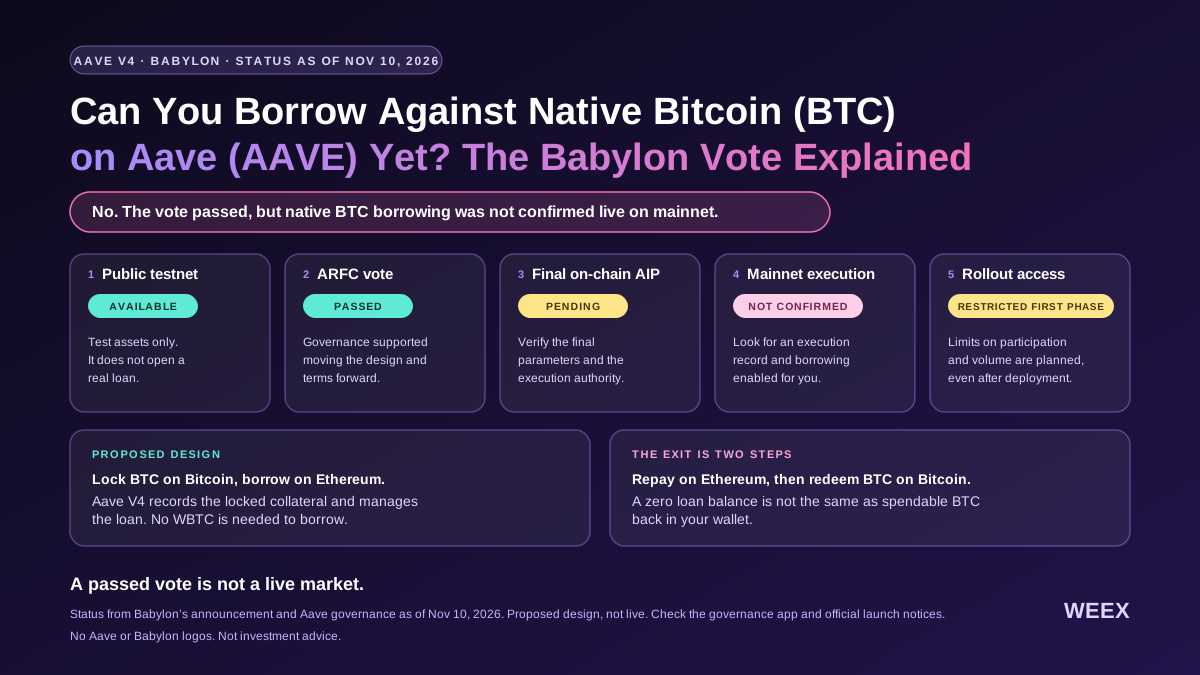
Can You Borrow Against Native Bitcoin (BTC) on Aave (AAVE) Yet? The Babylon Vote Explained
Can you borrow against native Bitcoin on Aave yet? See what the Babylon vote approved, what still needs to launch, and how BTC liquidation would work.
Why Doesn't Bitcoin Always Rise When Stocks Rally?

Financial Commission to Manage Stock Market Volatility with Sidecars and High-Frequency Trading Checks
IMF urges Kenya to make crypto firms share customer data under Travel Rule

Kim & Chang Lawyer: "Excessive Responsibility Should Not Be Imposed on Stablecoin Issuers"
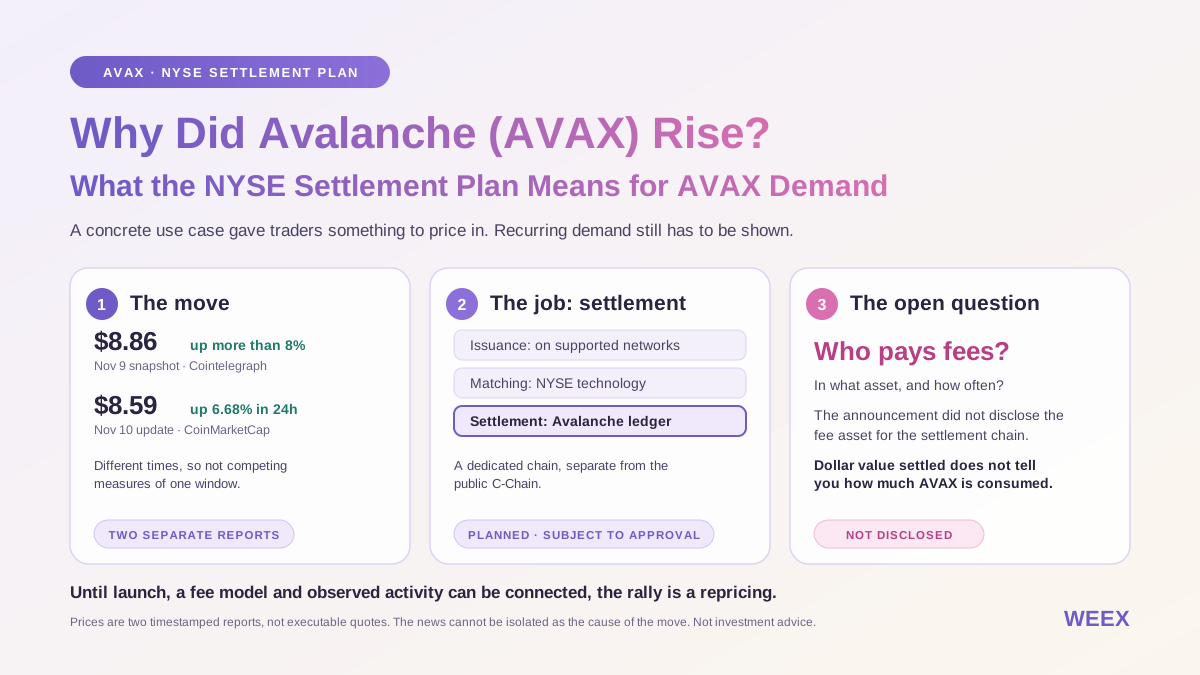
Why Did Avalanche (AVAX) Rise? What the NYSE Settlement Plan Means for AVAX Demand
See why Avalanche (AVAX) rallied after the NYSE settlement announcement, how the dedicated chain would work, and what could create demand for AVAX.

Cryptocurrency Security Checklist: Four Lessons from Phemex Safety Hub Vol. 05–08

Solana's Former DEX Leader Prepares to Go All In on US Stocks

PIEVERSE Price Up Nearly 80% in a Week: Futures Activity, the November 14 Unlock and What Is Confirmed
PIEVERSE rose about 79% in seven days with futures volume far above spot. See what is confirmed about the November 14 unlock and the WEEX Lucky Eggs campaign.

Unauthorized Access to Gnosis Pay's Old Card System Leads to Customer Data Breach

Alchemy Pay Says Mississippi Licence Expands US Money Transmission Coverage to 20 States
Hong Kong Approves Crypto Asset Reporting Rules - Fintech World

Biden's Son's LAPTOP Burns 5.5% as Conditions Met in U.S. Midterm Elections

TRON surpasses 413 million accounts, but what do network stats show?

Countdown to the GENIUS Act: Only USDC and PYUSD Pass Among the Top Ten Dollar Stablecoins
NVDA Stock Falls 4.3% After Board Opens Investigation: What Is Confirmed and What Is Not
NVDA closed at $178.67 on November 9, 2026, down about 4.3%, after Nvidia’s board confirmed an independent investigation. Other claims come from media reports. WEEX’s Lucky Eggs campaign runs until November 25.
How to Resolve Data Center Controversies? This U.S. State Wants to Tokenize Computing Power to Share Benefits with Residents

Lombard Systems Raises $4M to Make Tokenized Assets Easier to Borrow Against

When is the launch date of Bitcoin Hyper? Testnet, tokens, and mainnet are separate milestones

Westpac's Cryptocurrency Payment Limit (A$10,000): What Changes on December 1, 2026
Ethereum’s new P2P protocol doubles block delivery speed, Optimum says

Middle East Easing Expectations Boost Stocks | WEEX Daily Brief (November 10, 2026)
On November 9 close, the S&P 500 and Dow both rose more than 2%. Middle East easing expectations pushed oil prices lower. Bitcoin and Ethereum spot ETFs saw net outflows last week. AVAX rose on reports of tokenized-stock clearing. PIEVERSE surged short-term. November 10 focus is October CPI, TSMC monthly sales data, CoreWeave earnings and others.

Chainalysis Report: Why Did Western Europe Withstand the Global Crypto Market Chill?
Trump Media adds 1,510 Bitcoin in Q3 as treasury reaches $1.17B
Dormant Ethereum Wallet Moves $4.6 Million. Scammers Set a Trap in Three Minutes
47% Top Tax Rate Approaches: Seven Tax Reduction Strategies for Australian Crypto Investors
WEEX P2P now supports ILS, BHD, OMR & QAR —Merchant Recruitment Now Open
Hyperliquid Strategies Reports 38.5M HYPE Treasury After $802M Deployment
No Music App on Work Laptops: The Small Rules Behind WEEX Security
Latest articles


Latest coin listings on WEEX


