
IMF urges Kenya to make crypto firms share customer data under Travel Rule

 Prefer us on Google
The International Monetary Fund (IMF) has urged Kenya to require cryptocurrency platforms to share customers' identification details during digital asset transfers, as authorities work to strengthen anti-money laundering controls.
- IMF recommends Kenya require cryptocurrency platforms to exchange identifying information during covered digital asset transfers.
- Proposed Travel Rule requirements cover customer names, identification details, account references and cryptocurrency wallet addresses.
- Kenya's crypto regulations already require customer identification, while IMF recommends additional transaction information sharing obligations.
- Kenya remains on FATF's grey list as authorities work toward their April 2027 removal target.
- Kenyan social media users discussed cryptocurrency scams and regulatory pressure following the IMF's latest recommendations.
According to the IMF's November 6 technical assistance report, Kenya's crypto regulations need stronger information-sharing requirements aligned with international standards. The proposed measures would require covered platforms to collect, verify and transmit identifying information about people sending and receiving cryptocurrencies.
IMF calls for crypto customer data sharing under Travel Rule
The IMF identified gaps in Kenya's implementation of the Financial Action Task Force's Travel Rule, which requires covered virtual asset service providers to exchange customer information when processing transfers.
In its assessment, the lender stated that "a significant gap exists" concerning international information-sharing requirements for cryptocurrency transactions.
The recommendations call for providers to obtain and securely transmit sender and recipient details, including names, account references, physical addresses, identification numbers and wallet information.
When customers transfer cryptocurrency between exchanges, the sending platform would provide the required identifying information to the receiving institution before or during the transaction.
The receiving platform would use those details to identify the parties involved, screen transactions against sanctions lists and assess suspicious activity.
The IMF wants Kenya to incorporate these obligations into its Virtual Asset Service Providers regulations or another appropriate legal instrument without delay.
Information obtained through these procedures would support suspicious transaction reporting to the Financial Reporting Centre, Kenya's financial intelligence agency.
The recommendation has attracted attention on social media. Financial commentator Moe, posting as @moneyacademyKE, said the proposed rules would require platforms to identify people sending and receiving digital currencies.
The IMF now wants Kenya to introduce the Crypto Travel Rule, requiring crypto platforms to share the names and identification details of people sending and receiving digital currencies.
The aim is to help authorities track transactions and detect money laundering. --- Moe (@moneyacademyKE) November 10, 2026
Moe described the proposal as a measure intended to help authorities track cryptocurrency transfers and investigate possible money laundering.
Kenya's crypto regulations face additional compliance demands
Kenya introduced its first comprehensive cryptocurrency licensing framework through the Virtual Asset Service Providers Act, which took effect in November 2025.
The legislation assigns supervisory responsibilities to the Central Bank of Kenya and the Capital Markets Authority, depending on the activities conducted by each business.
The central bank oversees payment-related services and certain stablecoin activities, while the CMA regulates exchanges, brokers and investment-related providers.
As crypto.news previously reported, the CMA began preparing blockchain monitoring software capable of tracking transactions across more than 20 networks.
The proposed system would help regulators identify suspicious wallet activity and trace transfers across different blockchains.
Kenya's 2026 regulations already establish customer identification and recordkeeping obligations for licensed cryptocurrency businesses. However, the IMF recommends additional requirements for transmitting that information between institutions.
Compliance could require exchanges to update identity verification systems, establish secure information-sharing arrangements and integrate transaction monitoring software.
The obligations concern covered service providers. Direct transfers between individuals without a regulated intermediary present different enforcement challenges.
Kenya has remained on the FATF's grey list since February 2024 because of weaknesses in its anti-money laundering and counterterrorism financing framework.
In its October 30 assessment, the watchdog acknowledged improvements in financial supervision, beneficial ownership reporting and financial intelligence.
However, FATF called for further action on transparency requirements and money laundering investigations and prosecutions.
Kenyan authorities are targeting April 2027 for removal from the list, although that decision depends on FATF's assessment of completed reforms.
The latest recommendations have drawn criticism from some Kenyan social media commentators.
In a November 10 post, Ben Benares argued that international financial institutions place disproportionate regulatory pressure on developing countries.
He claimed that financial centers in wealthier economies continue to face problems involving illicit capital despite stricter oversight elsewhere.
His comments expressed opposition to the international regulatory pressure facing Kenya, while FATF's published assessment identified specific deficiencies that authorities still need to address.
Kenya has become Africa's third-largest cryptocurrency market after South Africa and Nigeria, according to Chainalysis figures cited in local reporting.
The estimates show that Kenyans transferred approximately KSh740 billion, equivalent to $5.7 billion, in cryptocurrency during the year ending June 2026.
Stablecoins account for much of the country's digital asset activity, including cross-border payments, remittances and transactions involving imported goods.
Peer-to-peer trading remains common, with users arranging cryptocurrency purchases and sales directly or through informal intermediaries.
In another social media post, Moe discussed the IMF's concerns about widespread P2P trading and cryptocurrency scams in Kenya.
The IMF says peer-to-peer (P2P) cryptocurrency transactions are widespread in Kenya and have contributed to scams.
It wants Kenya to introduce rules requiring crypto platforms to identify people sending and receiving digital currencies. --- Moe (@moneyacademyKE) November 10, 2026
The IMF's January 2025 assessment documented complaints involving informal transactions where customers transferred money but never received the promised cryptocurrency.
Kenya's Data Protection Act, 2019, meanwhile, governs the collection, processing and protection of personal information.
The country's Finance Bill 2026 proposals separately introduced additional reporting requirements for cryptocurrency platforms, including annual user and transaction disclosures to the Kenya Revenue Authority.
This content is provided for general informational purposes only and doesn't constitute financial, investment, legal, or tax advice. Any events, rewards, online promotions, or related information mentioned herein should not be considered a recommendation, solicitation, or invitation to purchase, sell, trade, or otherwise deal in any crypto assets. Crypto assets are highly volatile and may result in loss. The availability of WEEX services, products, and related events may vary by region. You are responsible for ensuring that your participation is in accordance with applicable local laws and regulations.
You may also like

WEEX P2P now supports ILS, BHD, OMR & QAR —Merchant Recruitment Now Open

Why Doesn't Bitcoin Always Rise When Stocks Rally?
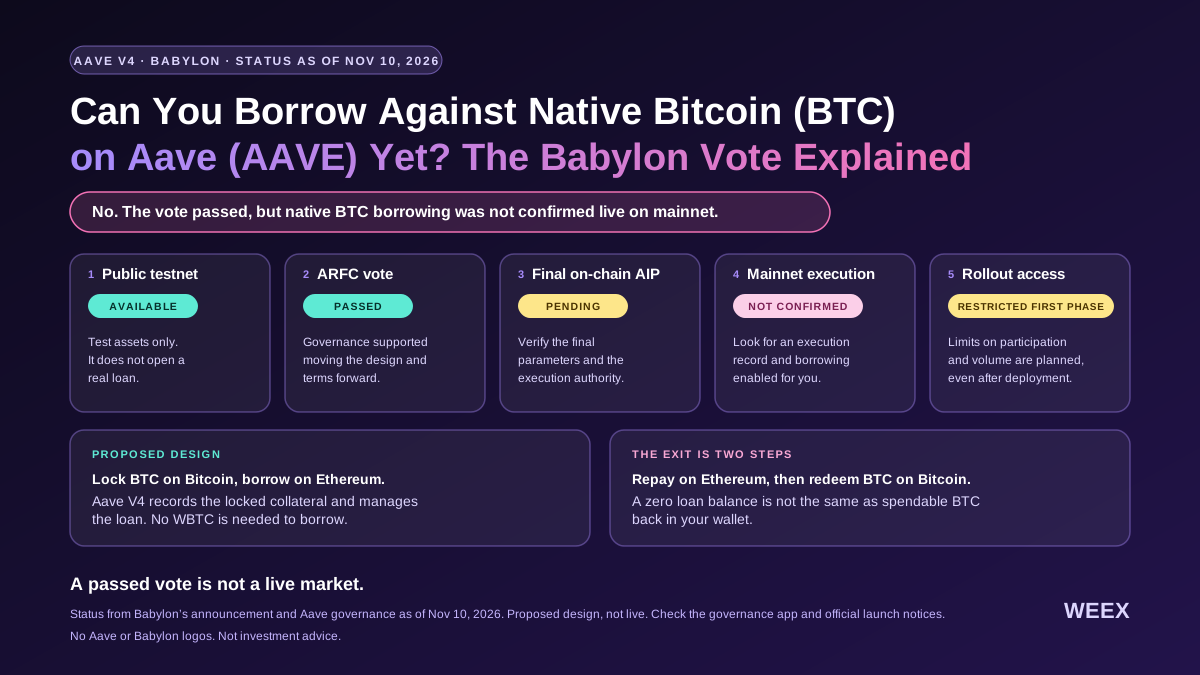
Can You Borrow Against Native Bitcoin (BTC) on Aave (AAVE) Yet? The Babylon Vote Explained
Can you borrow against native Bitcoin on Aave yet? See what the Babylon vote approved, what still needs to launch, and how BTC liquidation would work.

Financial Commission to Manage Stock Market Volatility with Sidecars and High-Frequency Trading Checks
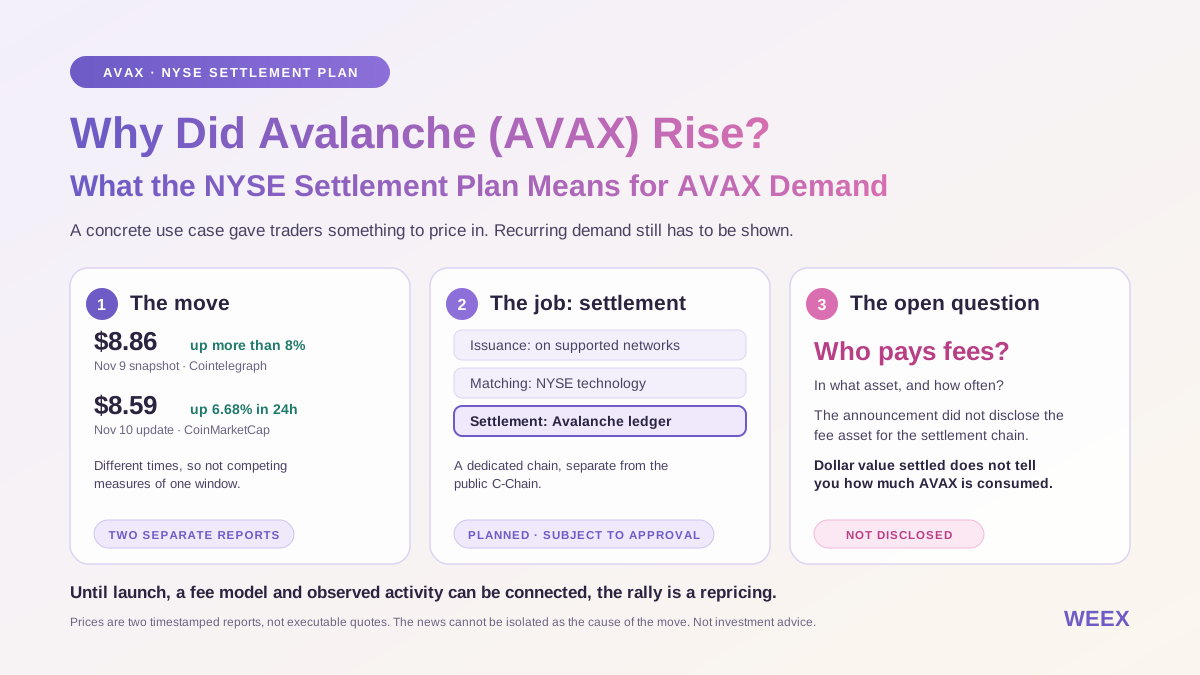
Why Did Avalanche (AVAX) Rise? What the NYSE Settlement Plan Means for AVAX Demand
See why Avalanche (AVAX) rallied after the NYSE settlement announcement, how the dedicated chain would work, and what could create demand for AVAX.

Kim & Chang Lawyer: "Excessive Responsibility Should Not Be Imposed on Stablecoin Issuers"

Cryptocurrency Security Checklist: Four Lessons from Phemex Safety Hub Vol. 05–08

Solana's Former DEX Leader Prepares to Go All In on US Stocks

Unauthorized Access to Gnosis Pay's Old Card System Leads to Customer Data Breach

Alchemy Pay Says Mississippi Licence Expands US Money Transmission Coverage to 20 States

Hong Kong Approves Crypto Asset Reporting Rules - Fintech World

Biden's Son's LAPTOP Burns 5.5% as Conditions Met in U.S. Midterm Elections

TRON surpasses 413 million accounts, but what do network stats show?

Countdown to the GENIUS Act: Only USDC and PYUSD Pass Among the Top Ten Dollar Stablecoins

NVDA Stock Falls 4.3% After Board Opens Investigation: What Is Confirmed and What Is Not
NVDA closed at $178.67 on November 9, 2026, down about 4.3%, after Nvidia’s board confirmed an independent investigation. Other claims come from media reports. WEEX’s Lucky Eggs campaign runs until November 25.

How to Resolve Data Center Controversies? This U.S. State Wants to Tokenize Computing Power to Share Benefits with Residents

Lombard Systems Raises $4M to Make Tokenized Assets Easier to Borrow Against

When is the launch date of Bitcoin Hyper? Testnet, tokens, and mainnet are separate milestones

Westpac's Cryptocurrency Payment Limit (A$10,000): What Changes on December 1, 2026
Ethereum’s new P2P protocol doubles block delivery speed, Optimum says

Middle East Easing Expectations Boost Stocks | WEEX Daily Brief (November 10, 2026)
On November 9 close, the S&P 500 and Dow both rose more than 2%. Middle East easing expectations pushed oil prices lower. Bitcoin and Ethereum spot ETFs saw net outflows last week. AVAX rose on reports of tokenized-stock clearing. PIEVERSE surged short-term. November 10 focus is October CPI, TSMC monthly sales data, CoreWeave earnings and others.

Chainalysis Report: Why Did Western Europe Withstand the Global Crypto Market Chill?

Blockchain.com Adds Trading API for Institutional Crypto Execution

The "Monopolist" Behind $4.6 Billion Tokenized U.S. Stocks: 91% of Assets Are Custodied by the Same Company?

LNbits disables hosted Bitcoin services with no restart timeline
Ray Dalio Warns of Diminished Trust in U.S. Treasuries Amid Political Conflicts

Government Considers Expanding Domestic Communication Surveillance, Plans to Amend Active Cyber Defense Law; Financial Services Agency to Establish Cybersecurity Guidelines for Cryptocurrency Exchanges in April

BitPay Brings Apple Pay and Google Pay Checkout to Crypto Purchases

Circle moves USYC fund into longer-dated US Treasury bills

Four Security Strategies from the Wallet Theft Incident
WEEX P2P now supports ILS, BHD, OMR & QAR —Merchant Recruitment Now Open
Why Doesn't Bitcoin Always Rise When Stocks Rally?
Can You Borrow Against Native Bitcoin (BTC) on Aave (AAVE) Yet? The Babylon Vote Explained
Can you borrow against native Bitcoin on Aave yet? See what the Babylon vote approved, what still needs to launch, and how BTC liquidation would work.
Financial Commission to Manage Stock Market Volatility with Sidecars and High-Frequency Trading Checks
Why Did Avalanche (AVAX) Rise? What the NYSE Settlement Plan Means for AVAX Demand
See why Avalanche (AVAX) rallied after the NYSE settlement announcement, how the dedicated chain would work, and what could create demand for AVAX.
Kim & Chang Lawyer: "Excessive Responsibility Should Not Be Imposed on Stablecoin Issuers"
Latest articles
Latest coin listings on WEEX


